
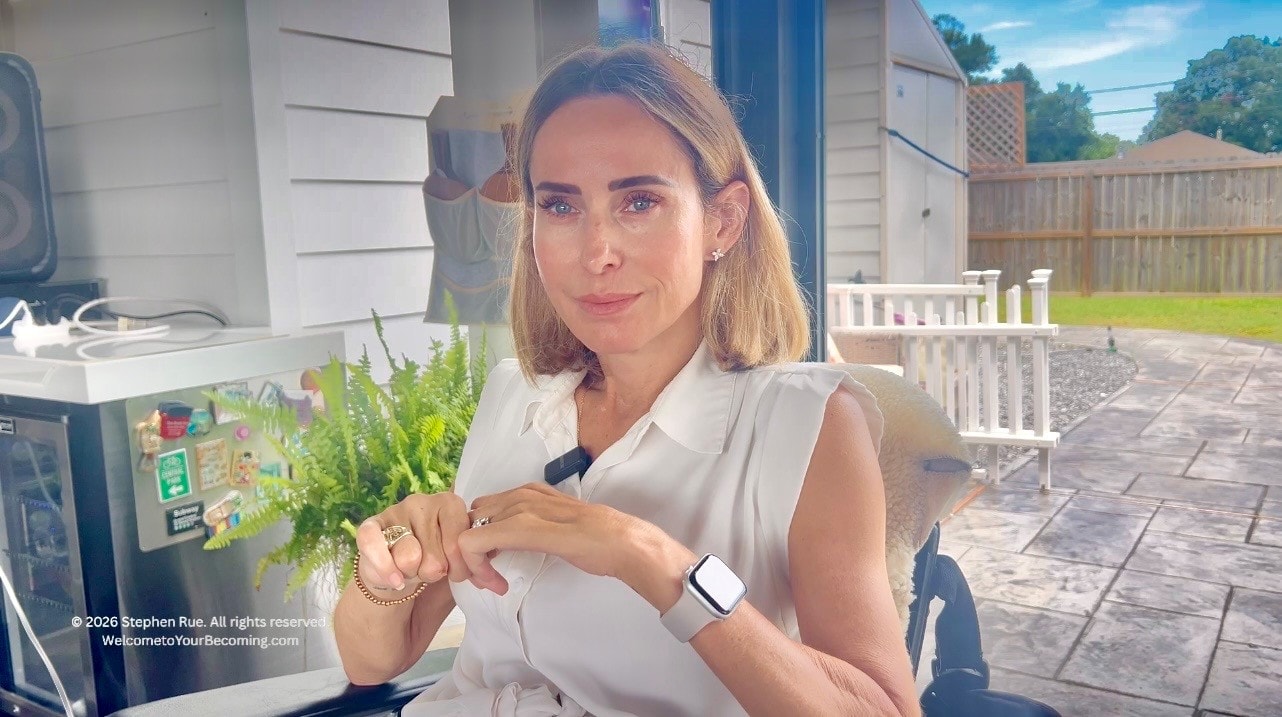
Real human beings sharing their life with you.
The Conversations Behind the Book
Interviews
Real Conversations About Who We Are, What Changes Us, and Who We Are Becoming
There are questions we answer almost every day.
What do you do?
Where are you from?
How are you?
Then there are the questions we rarely ask.
What changed you?
What have you survived?
Whom do you miss?
What do you understand now that you did not understand before?
What experience divided your life into a before and an after?
Who were you before it happened?
Who are you now?
Who are you becoming?
Those are the conversations at the heart of Welcome to Your Becoming.
These interviews are not about presenting perfect people.
They are about listening to real people long enough for something real to emerge.

We Are Not Looking for Sound Bites.
A Welcome to Your Becoming interview is not primarily about someone's résumé.
It is not a promotional interview.
It is not an attempt to manufacture an inspirational story.
And it is not designed to make every difficult experience end with a neat lesson.
These conversations may move through love, loss, identity, family, faith, doubt, friendship, disability, grief, parenthood, pain, rejection, forgiveness, loneliness, purpose, success, failure, regret, hope, aging, resilience, and the moments that quietly changed everything.
Sometimes an interview begins in one place and travels somewhere neither person expected.
That is part of the conversation.
The objective is not to force an answer.
The objective is to create enough space for an honest one to emerge.
"Sometimes the most important part of an interview begins after the question you thought you were asking."
— Dr. Stephen Rue
Some Stories Cannot Be Understood in Sixty Seconds.
Modern communication often asks us to compress complicated human experiences into captions, clips, posts, headlines, and sound bites.
But human lives do not happen in sound bites.
Grief is complicated.
Family is complicated.
Love is complicated.
Forgiveness is complicated.
Faith can be complicated.
Disability is complicated.
Identity is complicated.
Starting again is complicated.
A person may laugh while describing something painful.
They may cry over something they believed they had already resolved.
They may discover what they believe while trying to explain it.
That is why some Welcome to Your Becoming interviews are intentionally long-form.
The objective is not length for the sake of length.
It is time.
Enough time to settle into the conversation.
Enough time to move beyond the rehearsed answer.
Enough time to remember.
Enough time to reflect.
Enough time to listen.
Enough time to be heard.
Featured Interview
Macy
When Life Becomes Divided Into Before and After
Macy sat down with Dr. Stephen Rue for an extended conversation about a life changed in an instant—and about everything that continued afterward.
Before her accident, Macy was a lawyer, a mother, a professional, and a woman navigating the responsibilities and relationships of everyday life.
Then came an automobile accident.
A spinal cord injury changed the physical circumstances of her life and confronted her with questions about identity, motherhood, independence, pain, accessibility, relationships, faith, forgiveness, purpose, and the future.
But this is not simply an interview about an accident.
It is a conversation about what happens when one event divides life into:
before
and
after.
There was a Macy before the accident.
There is Macy after the accident.
And there is also the Macy who continues to emerge.
Watch the Full Conversation with Macy
Take your time. This is a long-form conversation. You do not have to watch it all at once. Listen as you might listen if Macy were sitting across from you telling you what her life has actually been like. There are no thirty-second answers required here.
What Macy Talks About
Identity
What happens when something central to the way you understood yourself changes? Who are you when the future you expected is no longer the future in front of you?
Motherhood
Macy speaks about motherhood while navigating profound physical changes. Her experience raises questions about independence, dependence, vulnerability, responsibility, and continuing to be a mother when the practical realities of daily life have changed.
Pain
The conversation does not pretend that resilience eliminates suffering. Pain remains part of Macy's lived experience. Sometimes the question is not simply: How do I eliminate pain? But: How do I continue building a meaningful life while pain is still present?
Rehabilitation and Progress
After life-altering injury, progress can acquire a different meaning. Something appearing small to an outsider can represent enormous persistence, frustration, courage, effort, and hope.
Faith
Macy's faith is an important part of how she understands her experience and future. Allow faith to remain personal and authentic rather than reducing it to a slogan.
Forgiveness
The conversation enters difficult questions involving relationships, hurt, anger, boundaries, and forgiveness. Not every wound has a simple resolution.
Accessibility and Belonging
Living with disability can reveal parts of society that many others never have to notice. Accessibility affects more than ramps and doorways. It can affect participation, independence, dignity, belonging, and whether someone feels that the world has genuinely made room for them.
Purpose
The accident changed many things. It did not eliminate Macy's desire to contribute. Her experience has helped inspire a desire to make the path less confusing and isolating for other people living with spinal cord injuries.
"Don't let a moment define a lifetime."
— Macy
Macy's conversation demonstrates the kind of storytelling Welcome to Your Becoming seeks to preserve.
Not perfection.
Not a manufactured comeback.
Not a simple claim that every painful experience eventually becomes easy.
Instead, we meet someone speaking from inside a life that is still unfolding.
Macy is still adapting.
Still parenting.
Still believing.
Still experiencing pain.
Still questioning.
Still hoping.
Still pursuing purpose.
Still deciding what freedom, identity, connection, and possibility mean now.
Macy is still becoming.
The accident may initially draw someone into Macy's story.
But the longer we listen, the clearer something becomes.
Macy is not simply a spinal cord injury.
She is not simply a lawyer.
She is not simply a mother.
She is not simply a person living with pain or disability.
She is a human being with a complicated past, present, and future.
That distinction is fundamental to Welcome to Your Becoming.
No person should be reduced to the worst thing that happened to them.
And no person should be reduced to their greatest accomplishment either.
We contain more than one story.
Interview
Rusty
When Strength Had to Mean Something Different
Rusty's life had long been connected to physical strength, training, competition, discipline, and helping other people improve themselves.
He understood pushing the body.
He understood effort.
He understood physical achievement.
Then an accident presented him with an entirely different definition of strength.
Rusty found himself using a wheelchair and confronting predictions about what he might never be able to do again.
For a period, despair became part of his experience.
But it did not become the final chapter.
Identity
What happens when something central to your identity suddenly changes? If you have always understood yourself through strength, independence, physical ability, competition, or helping others, what happens when circumstances force you to reconsider those things? Sometimes becoming begins with grieving an identity you expected to keep.
Despair
Not every story of moving forward begins with optimism. Sometimes there is a period when a person simply cannot imagine a meaningful future. Rusty's story does not need that darkness edited away. Sometimes becoming begins before hope feels believable.
Prayer and Faith
Prayer became part of Rusty's movement forward. Faith did not erase what happened. It became one of the ways he began searching for another direction.
Purpose
One of the important parts of Rusty's story is that while his circumstances changed, his desire to help other people remained. The form changed. The purpose remained.
The circumstances changed. The desire to contribute did not.
Watch or Listen to Rusty's Story
Rusty's conversation reminds us that strength can change its meaning. What begins as a story about physical ability becomes a conversation about identity, despair, prayer, persistence, contribution, and purpose.
More from Rusty's conversation coming to Welcome to Your Becoming
Similar Circumstances Do Not Create Identical Stories.
There are surface similarities between Macy's and Rusty's experiences.
Both experienced major physical disruption.
Both faced challenges involving mobility.
Both confronted questions about identity.
Both had to reconsider what the future might look like.
But their stories are not interchangeable.
Their personalities are different.
Their relationships are different.
Their experiences are different.
Their interpretations are different.
Their faith is personal.
Their struggles belong to them.
Their conclusions belong to them.
That matters.
Welcome to Your Becoming is not searching for people who all arrive at the same predetermined lesson.
The purpose is to listen closely enough to discover what each individual life actually says.
Interviews — Welcome to Your Becoming
What Might We Ask You?
There Is No Script to Memorize.
A Welcome to Your Becoming interview is a conversation.
Possible questions include:
Who were you before this happened?
What changed?
What was the moment when you knew life would be different?
What did other people misunderstand about what you were going through?
Who showed up for you?
Who surprised you?
What frightened you?
What did you lose?
What did you discover?
How did your relationships change?
Did your faith change?
Did your understanding of yourself change?
What do you understand today that you did not understand before?
What would you tell someone going through something similar?
What part of your story do people usually miss?
When have you felt truly seen?
When have you felt invisible?
What do you still struggle to understand?
Who are you becoming now?
Not every participant is asked every question.
Sometimes the most meaningful question emerges simply because someone listened carefully to the answer that came before it.
You Do Not Have to Survive a Catastrophe to Belong Here.
This project welcomes stories involving major life changes.
But we are equally interested in quiet human moments.
Your story might involve:
Friendship
Marriage
Divorce
Parenthood
Grandparenthood
Losing a parent
Caregiving
A teacher or mentor
Unexpected kindness
Rejection
Career change
Retirement
Starting over
Love later in life
Faith
Doubt
Forgiveness
Loneliness
Reconciliation
Aging
A mistake
A second chance
Finding purpose
Losing certainty
Saying "I love you"
Failing to say something before it was too late
An ordinary day that eventually became extraordinary in your memory
There is no minimum level of drama required.
There is only the question:
Did It Matter to You?
"You do not have to have lived an extraordinary life to have experienced an extraordinary human moment."
— Dr. Stephen Rue
What Happens Before an Interview?
Participation Is Voluntary.
If you tell us you are interested in being interviewed, the project may first contact you for a brief conversation.
That conversation may explore:
What happened
Why the story matters to you
What aspect you most want others to understand
Whether an interview might be written, audio, video, or another format
Your preferences regarding identification
Subjects you do not wish to discuss
Privacy concerns
Other identifiable people involved in the story
Whether additional permissions may be appropriate
Expressing interest does not obligate you to participate.
Expressing interest does not guarantee that an interview will be scheduled or published.
During the Interview
This Is a Conversation, Not an Interrogation.
There is no expectation that every answer will be polished.
There may be pauses.
There may be emotion.
There may be laughter.
There may be silence.
A memory may lead somewhere unexpected.
A participant may need time to think.
A participant may decide not to answer a particular question.
Where appropriate, someone may simply say:
"I'd rather not discuss that."
or:
"Can we move to something else?"
The objective is not forced disclosure.
The objective is understanding.
After the Interview
Depending on the participant's permissions and the nature of the conversation, Welcome to Your Becoming may:
Publish the full interview
Publish an edited version
Create shorter excerpts
Publish video clips
Use selected quotations
Create written summaries
Consider themes or portions for the book
Ask follow-up questions
Invite another conversation
Create related project or social-media content
Decide not to publish some or all of the material
Editing may occur for:
Length
Clarity
Repetition
Organization
Privacy
Legal considerations
Presentation
Audio or video quality
Relevance
Editing should seek to preserve the participant's essential meaning and voice.
Privacy, Permission, and Choice
Your Story Is Personal. Your Choices Matter.
Depending on the format, participants may discuss identification preferences including:
Full name
First name only
Pseudonym
Anonymous attribution where practical and appropriate
Video presents different privacy considerations because a person's image and voice may themselves reveal identity.
Privacy preferences should therefore be discussed before publication.
Welcome to Your Becoming is a storytelling, book, and media project. An interview is not a legally privileged conversation with a lawyer, physician, therapist, clergy member, or other professional. Participants should not disclose information they are legally prohibited from sharing or highly sensitive personal information that is unnecessary to the story.
If a conversation involves significant allegations against an identifiable third party, private information concerning another person, minors, pending legal matters, criminal accusations, another person's medical information, or similarly sensitive matters, the project may edit, omit, request clarification, request additional permission, or decline to publish that material.
Our purpose is meaningful storytelling.
Not unnecessary exposure.
You Are Allowed to Have Boundaries.
Some stories are painful.
Agreeing to participate does not mean every part of someone's life must become public.
Sharing one part of your story does not require sharing every part.
A participant may choose to keep certain experiences private.
If discussing grief, trauma, mental health, or another difficult experience becomes overwhelming, participants should consider pausing and seeking appropriate personal or professional support.
Welcome to Your Becoming is a storytelling and book project and is not a substitute for medical treatment, therapy, crisis intervention, or legal services.
Why Dr. Stephen Rue Conducts These Conversations
Listening Is Part of the Project.
For decades, Dr. Stephen Rue has spent much of his professional life listening to people experiencing moments they did not expect.
Divorce.
Conflict.
Fear.
Loss.
Change.
Transition.
But Welcome to Your Becoming asks something beyond:
What happened?
It asks:
What did what happened do to you?
How did it change the way you see yourself?
How did it change the way you understand other people?
What did it teach you about love?
What did it teach you about time?
What are you carrying?
What have you released?
What remains unfinished?
Stephen is not standing outside this project simply analyzing other people's lives.
He is becoming too.
Many of his reflections emerge while walking with his dog, Evie, when the professional noise becomes quieter and there is enough room to consider the stories people have entrusted to him, his own experiences of love and loss, and the questions connecting one human life to another.
The interviews are not simply research.
They are conversations.
Would You Like to Be Interviewed?
Your Story May Belong in This Conversation.
You do not need a public platform.
You do not need to be famous.
You do not need to be an author.
You do not need to be an expert.
You do not need to have survived a catastrophe.
And you do not need to have figured everything out.
Sometimes conversation itself helps us understand what a story means.
If there is something in your life another person might recognize, learn from, understand, or simply need to hear, we invite you to tell us about it.
Tell Us About Your Story
Know Someone We Should Meet?
Sometimes You Recognize the Power of Someone Else's Story Before They Do.
Perhaps you know:
a caregiver,
a teacher,
a parent,
a grandparent,
a widow or widower,
a person living with disability,
a veteran,
a nurse,
a doctor,
a first responder,
a business owner,
someone rebuilding after divorce,
someone starting over later in life,
or simply someone whose life taught you something you never forgot.
We would like to hear about them.
Please do not provide highly sensitive information about another person without permission.
Simply tell us enough to understand why you believe their story deserves to be heard.
If Stephen Were Sitting Across From You…
If you had one uninterrupted hour and someone genuinely wanted to listen—
what would you talk about?
The greatest loss of your life?
The person who saved you?
The person you miss?
A mistake?
A second chance?
Your marriage?
Your divorce?
Your mother?
Your father?
Your children?
Your faith?
Your doubts?
The life you thought you would have?
The life you actually have?
Something you still do not understand?
Something you finally do?
The question is not whether your story is impressive.
The question is whether it is yours.
Pull Up a Chair.
There is no requirement that your life be finished before you tell part of its story.
None of the people in this project are finished.
Neither is Stephen.
Neither are you.
That is why this project is called:
Welcome to Your Becoming.
Be Seen.
Be Heard.
Be Understood.
Interviews featured through Welcome to Your Becoming contain the personal experiences, memories, perspectives, and opinions of individual participants. Inclusion does not constitute independent verification or endorsement of every statement made. Interviews may be edited for clarity, length, privacy, legal considerations, or presentation. Participation and publication are subject to applicable permissions and project terms.